|
Rietvlei Water Quality |
 |
|
The Annual Water Quality Report
for Rietvlei and the Diep River
was presented to the Rietvlei
Management Working Group on 29
May 2013. The report is in pdf
format and can be viewed here. |
|
»
Click here to open report. |
|
|
|
Water Quality in Rietvlei North
Lake |
|
Monthly records of the water
quality in Rietvlei date back to
the year 2000, prior to that
there are results from sporadic
sampling. The results are
utilised for both environmental
health purposes (i.e. human
health) and to assess the
ecological health of the system. |
|
In May Candice Haskins of the
City’s Catchment, Stormwater and
River Management Department
presented her annual Water
Quality Report to the Rietvlei
Management Working Group. Here
we have extracted results from
her report for information about
the current situation in
Rietvlei North Lake, the
watersports area. The graphs
below are all from the Water
Quality Report. |
|
|
|
E. coli trend |
|
E. coli (Escherichia
coli) is an anaerobic,
rod-shaped bacterium that is
commonly found in the lower
intestine of warm-blooded
organisms. Most E. coli strains
are harmless, but some serotypes
can be harmful to humans. The
harmless strains are part of the
normal flora of the gut, and can
benefit their hosts by producing
vitamin K2,
and by preventing the
establishment of pathogenic
bacteria within the intestine. |
|
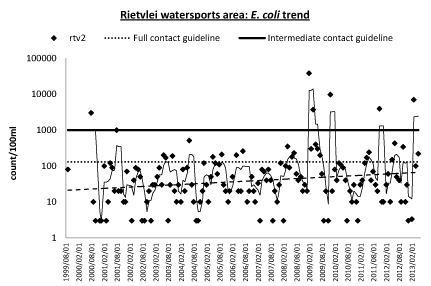
E coli is a good
indicator of pollution levels,
the number of bacteria in a
100ml of water is counted - high
levels can be harmful to people
using the water. |
 |
|
The full contact and
intermediate contact guidelines
are applied in recreational
areas and indicate the
suitability of the water for
recreational use. Full contact
is significant and lengthy full
body immersion associated with
swimming and diving; while
intermediate contact is partial
contact that would take place
during paddling, splashing and
brief immersion such as when a
vessel capsizes. The guideline
for full contact is the E.coli
counts must be less than
130/100ml of water; intermediate
contact guideline is less than
1000 counts/100ml of water. |
|
In the graph above it can be
seen that, while the E.coli
counts are mostly below the full
contact guideline, it does at
times exceed 130/100ml and
occasionally the intermediate
contact guideline of
1,000/100ml. What is significant
is that the trend indicates that
the E.coli counts in North Lake
have been increasing since 2000. |
|
While the water quality in North
Lake is currently suitable for
full contact recreational use
most of the time, it is strongly
recommended that full contact be
avoided – this means no swimming
or diving. Intermediate contact
recreational use is reasonably
safe, but we advise people not
to stay in the water for long
periods. |
|
|
|
Inorganic Nitrogen and Total
Phosphate |
|
Nutrient levels in rivers,
lakes, estuaries and the sea are
indicated by measuring inorganic
nitrogen and the total phosphate
in the water. Nutrients are
essential for living organisms,
in a natural unimpacted system
the levels of nutrients are
finely balanced to ensure
optimum productivity. The
absence of inorganic nitrogen or
phosphates means that the system
is sterile and devoid of most
life forms, but if the levels
are too high excessive plant
growth leads to rapid turnover
of plant material, particularly
phytoplankton, decomposing plant
material results in anoxic
conditions. |
 |
|
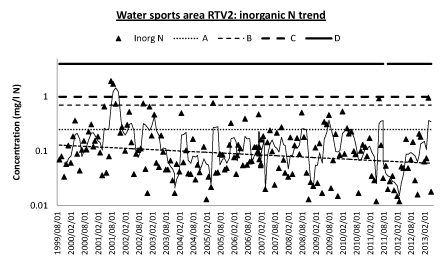
Nitrogen levels of about 0.25
mg/l N are natural, levels up to
4 mg/l N are still acceptable.
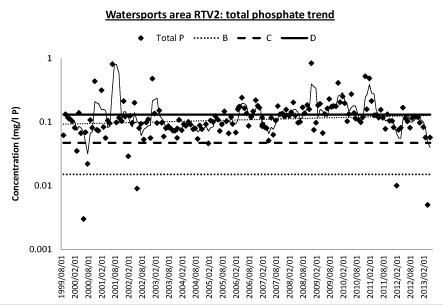
Total phosphate levels up to 1.3
mg/l P are acceptable, with the
optimum levels being about 0.01
mg/l P. In Rietvlei nitrogen
levels are in the lower ranges
with only occasional peaks above
0.25 mg/l N; the trend since
1999 shows a steady decline in
nitrogen levels with lower and
less numerous peaks in the last
3 years. |
 |
|
The total phosphate in Rietvlei is quite high, there
was a steady increase from 1999 to early 2011,
however since then there has been a marked
improvement with phosphate levels dropping below 1.3
mg/l P. |
|
|
|
Chlorophyll-a |
|
Algal blooms are a common occurrence in Rietvlei,
the quantity of algae is determined by measuring
chlorophyll-a. Algal blooms often result in anoxic
conditions, i.e. dissolved oxygen in the water is
used up by the algae and this seriously affects
aquatic life in the system. In extreme cases the
algae form a thick unsightly and smelly scum on the
surface; fish deaths can occur which further adds to
the smell. At times the algae produce toxins that
can cause skin irritations and, if swallowed,
gastro-enteritis and impaired liver function. |
 |
|
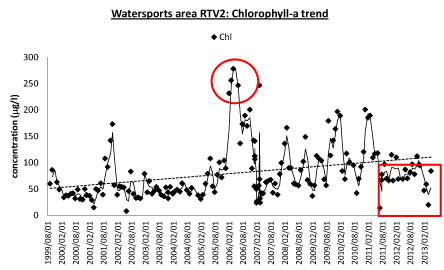
The graph shows that the levels of algae in Rietvlei
have been steadily increasing since 1999, but the
last two years shows an improvement with
significantly lower chlorophyll-a levels (red square
in graph). |
|
Fortunately all blooms are not toxic, it is only
when Microsystis blooms that one must be
extra cautious. The last Microsystis bloom
in Rietvlei was in January 2007 just after the fish
kill the previous month. Even though most algal
blooms are not harmful, the advice to recreational
users is to keep clear of algal blooms in the water
– most are fairly patchy and will cover relatively
small areas before dissipating. If the situation
really becomes bad, the authorities will timeously
close Rietvlei to recreational use until conditions
return to normal. |
|
|
|
Dissolved oxygen |
|
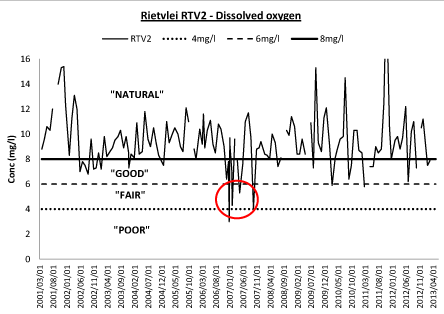
Dissolved oxygen is another
indicator of the ecological
health of the system. Low oxygen
levels are often the result of
algal blooms, but can also be
the result of pollutants in the
system when high organic loads
deplete the dissolved oxygen. |
 |
|
In December 2006 the oxygen
levels in Rietvlei dropped
dramatically, resulting in a
severe fish kill and subsequent
bloom of toxic Microsystis
algae (red circle in graph). The
cause for the drop in oxygen was
a period of hot windless summer
days (when the water temperature
increases the dissolved oxygen
levels drop); this was prime
conditions for algal blooms
which further decreased the
oxygen levels. |
|
The oxygen levels in Rietvlei
are mostly above 6mg/l and often
above 8 mg/l which is good;
oxygen levels above 8 mg/l are
found in natural unimpacted
systems. The occasional dip to
lower levels of dissolved oxygen
is most probably due to natural
conditions (like hot calm days)
and not as the result of
polluting factors. |
|
|
|
Conclusion |
|
The results of the water
sampling may appear to be
conflicting, some parameters
indicate high pollution levels,
while others indicate a healthy
system. This merely illustrates
the complexity of wetland
systems. |



